
*View accurate shipping rates and availability






11 Items


Up to 70% off across the store, plus free towels and mirrors up for grabs on orders over $800*


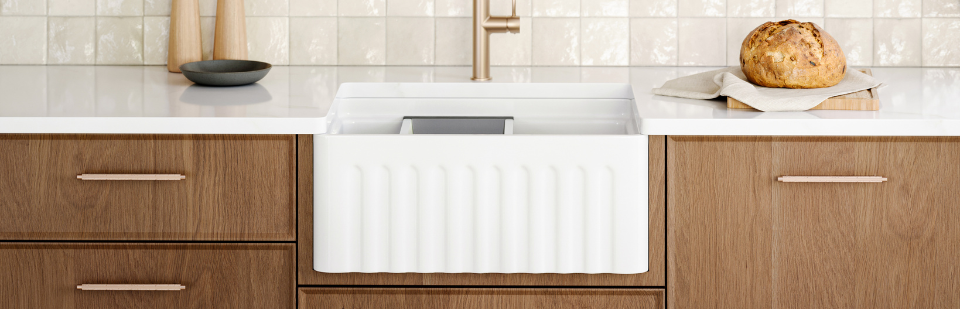


The Fienza Tiva range is polished 304 stainless steel kitchen sinks, from compact single bowls to long sinks with a built-in drainer. Every Tiva has its own specification sheet from the maker, and the sheets are the best guide to what each sink measures, holds and includes. This guide groups the Tiva sinks by layout, gives the sizes from the sheets, then covers mounting, hand, tap holes, wastes, accessories and care. The sensible way to choose is to start with the length of bench you can give the sink, then pick the layout that fits, then confirm the mounting method. For the other Fienza ranges, see Fienza kitchen sinks.
The maker describes the small single bowls as designed for smaller kitchens and outdoor living areas. Each is polished 304 stainless steel with a basket waste included, sealing tape and mounting clips included, and a choice of topmount or undermount fitting. The sheets give the overall size as length by width by depth, and the listings give the bowl size inside.
The 345's sheet gives 345mm long and 495mm wide, so it is deeper front to back than it is long, and the orientation is worth checking against the cabinet before ordering. The 365 is the smallest of the group on its sheet.
The double bowl sinks have two basket wastes included, and the sheets name the code A3 for both. The topmount and undermount options differ by model.
The 670 is an uneven pair, 25 and 13 litres, and the 785 and the 780 are even pairs. A retailer page describes a smaller second bowl as useful for rinsing vegetables or soaking utensils. A retailer guide says to choose a double bowl if you hand-wash often, prep vegetables or want a separate bowl for hand washing, and that the divider limits large items.
The drainer sinks are 480mm front to back and topmount only. The sheets list one tap hole as standard, and each comes in left hand and right hand versions, with codes ending in L or R. The listings call them an all-in-one solution with two bowls and a drainer, except the single, which is described as designed for smaller kitchens.
The step from one drainer sink to the next is 200mm from the 780 to the 980, then 100mm each to the 1080 and the 1180, which is how much more bench the longer layouts take. The main bowl is 330 x 380mm in all four. See 1.5 bowl kitchen sinks, 1.75 bowl kitchen sinks and double bowl kitchen sinks for the layouts across makers.
A retailer sizes guide says the sink should be at least 70 to 80mm narrower than the internal width of the base cabinet, which leaves room for the plumbing and hardware. A second guide says to leave 50 to 100mm between the back of the sink and the wall if a splashback is going in. Using the overall lengths on the sheets, the 980 points to an internal cabinet width of about 1050 to 1060mm, the 1080 to about 1150 to 1160mm and the 1180 to about 1250 to 1260mm. A 780mm sink points to about 850 to 860mm.
The same guide gives a clearance for a drainer sink of at least 300mm of clear bench beside the sink. All the Tiva drainer sinks are 480mm front to back, which sits inside the guide's 450 to 500mm range for a 600mm deep benchtop. Measure the cabinet, the benchtop and the wall run, not just the sink.
The sheets say the compact singles and the 670 and 785 doubles fit either way, and the rest are topmount only. A retailer guide says a topmount sink sits on the benchtop with the rim showing, works with almost every benchtop and is easier to replace than an undermount sink. Its downsides are a rim that can trap debris and silicone that can peel and let water into the cabinet. An undermount sink fixes beneath the benchtop with no rim, so crumbs sweep into the bowl. The same guide says it needs a waterproof solid benchtop such as engineered stone, granite, marble or concrete, and is not recommended for laminate or timber.
The sources do not always agree on the mounting. A retailer lists the 670 as flush mount, inset or drop in, and under mount, while another lists it as topmount or undermount. The sheet says topmount or undermount, and that is the figure to follow. A Houzz guide says caulking needs replacing every three to five years on both types. See undermount kitchen sinks and inset sinks for the methods.
The listings say sealing tape and mounting clips are included. The installation sheet for the small singles and the round sink is a diagram with labelled parts: silicone seal, screw, bracket, plug, sink and fixing clamp. The sheets do not give a cut-out size, and none of the sellers read gave one either. A retailer guide says to use the cut-out on the specification sheet or the template rather than the outer dimensions, and another warns that a cutting error can mean replacing the benchtop, which is why it advises a professional. Ask Fienza or the supplier for the cut-out before the benchtop is cut.
The drainer sinks come in left hand bowl and right hand bowl versions, with codes ending in L or R, such as 68105L and 68105R. A retailer guide says most drainer models are handed left or right, and that a flat or shallow drainer pools water, so look for deep grooves and a slope. The hand decides which way the wet dishes flow. Choose it with the person who washes up most and the run of the benchtop, and give the cabinet maker the choice before the opening is cut.
The drainer sinks have one tap hole as standard, and the compact singles and the 670 and 785 doubles are listed with none. A retailer guide says most sinks have one or two tap holes, and to check the count against the tap. With no tap hole, the tap goes on the benchtop or the wall, which suits a bench-mounted mixer or wall tapware. A deep sink may need a taller mixer or a pull-out, according to another guide. The Tiva bowls are 170 to 200mm deep by the sheets, which a sizes guide places in its shallow to standard bands. See kitchen taps for the options.
The sheets say the Tiva sinks include their basket wastes, coded A3, with A4 listed for the small bowl on the 980 and the listing for the 1080. A retailer lists the A3 wastes as 90mm and a basket waste for the 980 with a 50mm outlet and 70mm depth. The 1080 listing and its sheet disagree: the listing says one A3 and one A4, while the sheet says two A3. Check the waste against the pipework before the plumber arrives. A retailer guide says connecting the water supply and the tapware needs a licensed plumber in every state and territory. See sink wastes.
The sheets list optional accessories by code. The larger sinks take an oak chopping board (A6 or A7), a drainer basket (A11 or A12) and a drainer tray (A13 or A14), and some add a colander (A15 or A16). The compact singles list none. Matching accessories are sold on the Fienza kitchen sink accessories page. A guide says a grid protector sits just above the basin floor, prevents scratches and helps drainage.
The sheets say polished 304 stainless steel, and none states a thickness. A stainless steel guide describes 304 as about 18% chromium and 8% nickel, corrosion resistant but not completely rust-proof. A buyer's guide says a thicker sheet, which has a lower gauge number, limits flex, noise and denting, and that thin sheet can sound tinny, so look for sound pads or an undercoating. The sheets do not mention either, so check the product page. See stainless steel sinks for the material in general.
The maker's sheets give the same four lines for every Tiva. Dry off water droplets after use with a clean dry cloth. Once a week, use a detergent mixed with a small amount of ammonia and rub gently with a soft cloth, then rinse thoroughly with cold water and dry with a clean cloth. Do not use steel wool, abrasive cleansers or cleaning pads. Do not use chemical silver cleaners, bleaches or detergents containing chlorine or any of its derivatives.
The maker's weekly ammonia step differs from a buyer's guide that lists ammonia cleaners among the things to avoid on a sink. For a Tiva, the maker's own instruction is the one to follow. The guide agrees on the rest: warm water, mild dish soap, follow the grain, dry with microfibre to prevent water spots, and avoid abrasive powders and steel wool.
A small kitchen, an outdoor area or a butler's pantry points to the compact singles, since the maker describes them as designed for smaller kitchens and outdoor living areas. A kitchen that runs a dishwasher and washes large pots by hand suits a single bowl. A household that hand-washes and preps often suits a double. A drainer sink helps where bench is tight and the drainer would otherwise need its own space, as a buyer's guide says drainboard sinks do. See single bowl kitchen sinks for the single layouts across makers.
When a Tiva replaces an old sink, the old opening sets the limit. A retailer guide says to measure both the base cabinet and the existing benchtop cut-out before you order. Compare the old opening with the new sink's template once you have it. The topmount sinks are the more tolerant: a retailer guide says the rim covers the cut edge. Have the sink on site before the benchtop is cut, as another guide advises, and ask a stone mason about re-cuts if the benchtop is stone.
This page covers the Tiva sinks only. If you have not settled on a layout or a maker, the main kitchen sinks page lists every range. One guide counts 20 to 30 uses of a kitchen sink a day, so the size, the hand and the mounting are worth getting right before you order.


