
*View accurate shipping rates and availability






12 Items



Up to 70% off across the store, plus free towels and mirrors up for grabs on orders over $800*


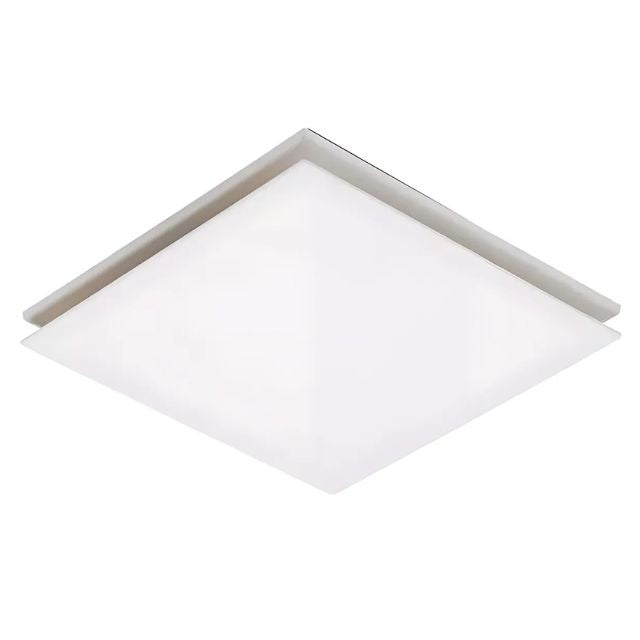


Martec makes bathroom exhaust fans in two kinds: plain exhaust fans, with or without a light, and 3-in-1 units that add infrared heat lamps to the fan and the light. This page holds four Martec units: the Flow and the Saturn, which are plain exhaust fans, and the Striker and the Forme, which are 3-in-1 units. Choosing between them comes down to the size of the bathroom, the duct you have, the hole in the ceiling and how the room is used. This guide takes those in turn and gives the figures from the specifications. Building rules differ by state and by building, so confirm them with a licensed electrician before you buy.
For other brands and more, see bathroom exhaust fans.
The method is the same everywhere. Multiply the room's length by its width and its height, in metres, to get the volume, then multiply by the air changes an hour you want. About 7 air changes an hour suits a bathroom without a shower and 15 one with a shower, and a busy shower room can run from 15 to 30. A lower figure of 8 to 10 also works when the answer is converted to litres a second. Taller ceilings, open showers and high humidity may call for a more powerful fan, and it is safer to overestimate than to underestimate.
Turning that around gives a rough guide to the Martec units, and this is arithmetic and not a rating. At 15 air changes an hour, an airflow of 180 cubic metres an hour covers a room of about 12 cubic metres, 300 covers about 20, 360 covers about 24, 443 covers about 30, 390 about 26 and 600 about 40. A small ensuite of 8 to 12 cubic metres suits the Saturn 270. A family bathroom of 15 to 20 cubic metres suits the Forme, the Striker or the Flow 265. A large bathroom with a high ceiling suits the Saturn 335 or the Flow 315. The air changes you choose, and the duct run, change those figures, so use them as a starting point.
Each unit takes a set duct. The Saturn 270 takes 100mm, the Flow 265, Striker and Forme take 125mm, and the Flow 315 and Saturn 335 take 150mm. Each extra metre of duct and each bend reduces the airflow you actually get, and long runs should use rigid duct and not flexible. Keep runs short with minimal bends and seal the duct so air cannot leak back. The Flow and Striker also have a side ducting access outlet, and the Flow has a draft stopper in that outlet, which suits a ceiling cavity where the duct runs sideways. The Saturn has a back draft damper or stopper.
The duct has to go outside. Building regulations generally require ducting to the outside and not into a roof or wall cavity, and moist air vented into a sealed roof has nowhere to go and can corrode metal and rot timber.
The hole in the ceiling and the space above it decide whether a unit fits. The Flow 265 needs a 240mm cut-out and 210mm of ceiling depth, and the Flow 315 needs 295mm and 240mm. The Saturn 270 needs a 240mm cut-out and 220mm of depth, and the Saturn 335 a 295mm cut-out and 220mm. The Striker has a 320 by 320mm cut-out and a minimum ceiling depth of 200mm. The Forme needs a depth of 200mm, a 320 by 320mm cut-out on the four-lamp version and 375 by 202mm on the two-lamp version. A cut-out template is supplied with the Forme. Measure the cavity before you order, and check for joists, because a ceiling fan must fit between them.
Position follows one rule. Place the fan close to the shower or bath, high in the ceiling, and away from the source of replacement air. A fan can only extract air if air can enter, so a window, a vent or a gap under the door is needed, and a 20mm gap under the door is the right size. Avoid placing a fan or heater directly above a shower recess, and check AS/NZS 3000 for the wet zone requirements.
The IP rating measures protection against dust and water. The zone directly above a shower requires a minimum of IP44 and the neighbouring zone also needs IP44 compliant products. The Flow is IPX2, and the Saturn, Striker and Forme IPX4. Ask the installer which zone the location falls in before choosing, and do not assume a rating fits every position.
Noise is measured in decibels or sones, and lower is quieter. The Saturn is under 45 decibels, and the Flow, Striker and Forme under 40. The Flow is 40 decibels or less.
The Flow and the Saturn come with or without a light. The Flow light is a 12 watt tricolour LED at 950 to 1,000 lumens, and it switches between 3000K and 5000K, with 4000K in between. The Saturn 335 has a 1,200 lumen LED. The Striker has a 12 watt R80 LED of 1,200 lumens with adjustable colour temperature, and a replaceable globe. The Forme has a 10 watt tricolour LED of 725 lumens. Warm light of about 2700K to 3000K suits relaxing rooms and neutral light of about 4000K suits task areas. Light output is measured in lumens and not watts.
The Striker and the Forme add infrared heat lamps to the fan and the light. The lamps are 275 watts each, and the units come with two or four. An infrared lamp gives instant warmth, and the Striker adds a half heat function that runs part of the lamps. 3-in-1 bathroom heater lights lists the Eglo, Martec and other combination units, and bathroom heaters lists heaters on their own. The 3-in-1 units are not a substitute for exhaust sizing: the fan in each unit has its own airflow figure, 300 cubic metres an hour on the Forme and 360 on the Striker, and that figure is what you size against.
The Flow is a low profile fan with a polypropylene housing and an ABS fascia, a swivel quick mount base for easier installation and built-in thermal overload protection, which cuts the motor if it overheats. The Saturn is plastic with a white fascia plate, installed with clamps that fit and secure the fan into the ceiling, and it is a high velocity fan with a back draft damper. Both are low profile and suit bathrooms, laundries and apartments. That matters where the ceiling cavity is shallow. The minimum depth figures above tell you how shallow: from 200mm on the 3-in-1 units to 240mm on the Flow 315.
A ceiling fan swap can be a DIY job when both the old and new fans have a lead and plug to a power point. The Flow comes with a flex and plug in the box, and the Saturn 270 with a cable and plug, so those two are plug-in. Fans that are hardwired need a licensed electrician, and hardwired fans must be installed by a licensed electrician under AS/NZS 3000 with the required RCD protection. The 3-in-1 units are hardwired to a multi-gang switch, so use an electrician for those.
Run the fan throughout the shower or bath and for at least 15 minutes afterward, because turning it off immediately does not vent all the steam, and open a window or the door while it runs. Condensation is most noticeable in winter and is the most common cause of winter mould. Clean the fan at least twice a year, and the panels come off for easy cleaning. Vacuum the grille every three to six months, because dust on the grille reduces airflow. Turn the power off before you clean, and let the grille dry fully.
For Martec ceiling fans, see Martec ceiling fans, and for exhaust fans from other brands exhaust fans only and Fanco bathroom exhaust fans. For heating and ventilation together, see bathroom heating and ventilation.


