
*View accurate shipping rates and availability






8 Items




Up to 70% off across the store, plus free towels and mirrors up for grabs on orders over $800*


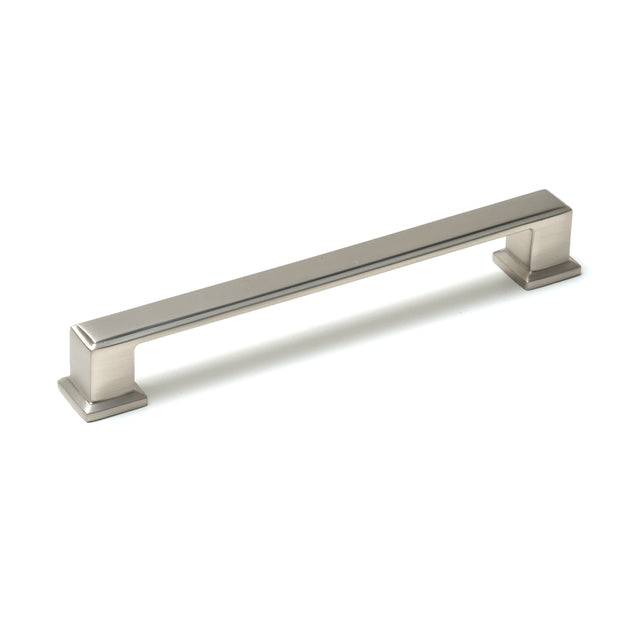
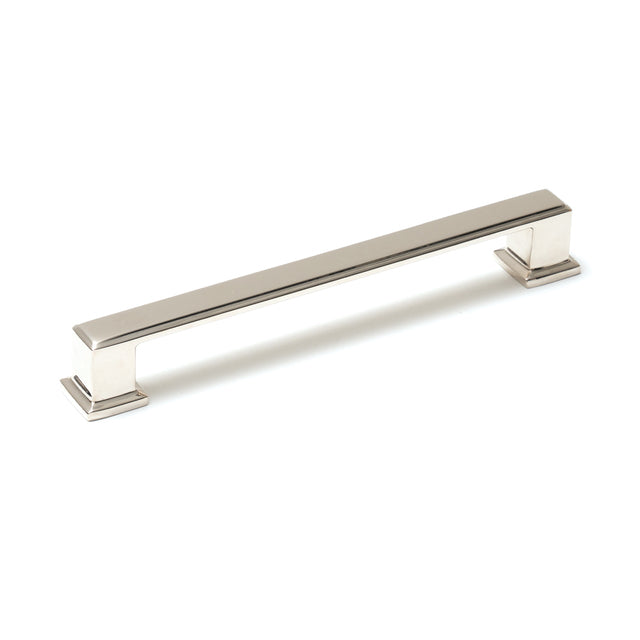
The Lucca is a zinc alloy range from Momo with a D handle, a cup pull and a square knob. It is a classic range suited to transitional cabinetry, with a stepped detail that runs across all three pieces. It comes in Dull Brushed Nickel, Polished Nickel and Brushed Satin Brass, with Matte Black on the knob. The page covers what the stepped detail is, what each piece measures, how zinc alloy with a plated finish behaves and what each finish looks like. The page also explains how to size, fit and clean the range. For the whole brand, start at Momo cabinet handles.
The Lucca is defined by stepped detailing and the tension between industrial weight and traditional form. The step is a raised shoulder that adds visual mass and tactile depth without ornamental excess, and the same shoulder is machined consistently across the knob, the cup pull and the D handle. One detail therefore runs through all three pieces, and a kitchen that uses all three keeps one visual language. Hold a sample to see how much the shoulder shows at the distance you will see the handle.
The Lucca D handle has fixing distances of 160mm and 320mm, with overall lengths of 182mm and 342mm. It is 22mm wide and projects 26mm. The fixing distance is the gap between the two screw holes, measured from centre to centre, so the D handle runs 22mm longer than its holes. The cup pull is on a 96mm fixing distance, 130mm overall, 22mm wide with a 26mm projection. The square knob is 30mm across, 30mm wide and projects 26mm.
All three share a 26mm projection and, where given, a 22mm width, which keeps a run of drawers and doors consistent in depth. Screws are not included. Screw length depends on the panel: 22mm for panels 16mm to 18mm thick, and 38mm for panels 32mm to 34mm thick. The screw must bite into the handle and stop short of the door face. The cabinet thickness is 16mm to 25mm.
When you replace a handle, measure the distance between the screw holes and match it to the fixing distance, not to the length of the old handle. A 128mm handle will not fit 160mm holes without new holes, so a 160mm Lucca D handle only drops into holes spaced at 160mm.
Zamak is a zinc-based alloy with aluminium, magnesium and copper. It is mostly die-cast, and it can be electroplated, wet-painted and chromate-conversion-coated well. The Lucca is zinc alloy with an electroplated finish, and the grade and the plating metal are not named. The surface finish provides corrosion resistance and long-term colour stability, and a die-cast zinc handle depends on its finish for corrosion protection. Thin electroplated zinc alloy can fail within a few years in a shower splash zone. Indoors, away from direct splash, it is a normal material. See zinc alloy cabinet handles for the material in full.
Treat the Lucca finishes as coated, and avoid abrasive cleaners and brass polish. The rule for mixing is to keep a room to two metals and repeat each at least twice so it reads as a decision. Mixing nickel with brass accents works.
Cup pulls on drawers and classic knobs on cabinet doors give a balanced look in traditional kitchens. Cabinet knobs fix at one point and work better on doors than on drawers, and bar pulls and D-pulls suit drawers, overhead cabinets and pantry doors. A pull is gripped with three or four fingers, which makes it the better choice for heavy drawers and for children and older people. Most cabinet knobs run roughly 25mm to 38mm across, so the 30mm Lucca knob sits in the middle of the common range. See cup pull cabinet handles, D shaped cabinet handles and square shaped cabinet handles.
Drawers 450mm to 600mm wide take 128mm to 160mm centres, and wider ones 256mm to 320mm, or two pulls. A standard door takes a 96mm to 128mm pull or a knob, and vanity drawers and doors usually take 96mm and 128mm centres. On the Lucca, the 96mm cup pull suits a vanity drawer or a small door, the 160mm D handle suits a drawer of 450mm to 600mm, and the 320mm D handle suits a wide drawer of 600mm to 900mm. The one-third rule says a pull is about a third as long as the drawer front is wide, so near 200mm for a drawer 600mm across. The 182mm D handle is the nearer size for that drawer.
A pull or knob sits 40mm to 60mm in from the edge that opens, near the bottom corner of an upper door and the top corner of a lower door. Pulls run horizontally on drawers and vertically on doors. To test a size before you buy, tape a strip cut to the handle's length onto the cabinet and live with it for a day.
Handle types pair with kitchen styles. Contemporary and minimalist kitchens go with matte black or brushed nickel pulls, and Japandi and Scandi kitchens with timber and brushed nickel. Hamptons and coastal kitchens go with D-pulls or cup pulls in brushed nickel, brushed brass or chrome. Shaker kitchens go with cup pulls, bin pulls or knobs in brushed brass, antique bronze or matte black, and heritage kitchens with antique bronze or aged brass and period knobs. The Lucca D handle and cup pull in nickel or brushed brass sit in the Hamptons and coastal note, and the black knob sits in the Shaker note. These matches are guidance and not rules.
A sample answers most of the remaining doubt. Hold the handle against the door, check where the fingers land, and look at the stepped detail in the light you will see it in. Test the grip against the door and choose a grip that suits all users, including larger hands or arthritic fingers. Check that the 26mm projection clears the neighbouring door when both open. Taping a strip cut to the handle's length onto the cabinet for a day also helps to judge scale, which works for a 182mm D handle as well as for a 342mm one.
When you swap handles, match the fixing distance. A new D handle with the same distance drops into the old holes without drilling. Measure from the centre of one screw hole to the centre of the other. If the old holes are on another centre, you will need to fill them or drill new ones, and a filled hole shows unless the door is repainted. A knob needs only one hole, so swapping a pull for a knob leaves one old hole unused and the other to fill.
Bathroom fittings need wiping and drying more often than those elsewhere, because steam and moisture leave marks. Bathrooms are more humid than kitchens, and solid brass, stainless steel and quality PVD are sound choices, with thin electroplated zinc alloy the one to avoid in a splash zone. Brushed Satin Brass and Dull Brushed Nickel suit transitional bathrooms. A vanity door with a Lucca knob well away from the shower is a fair use, and a handle in a splash zone is the case to avoid. The cabinets these handles fit are at bathroom vanities and furniture.
Put the cleaner on the cloth and not on the hardware, and dry the handle straight away so water marks do not form. For coated finishes, use a soft microfibre cloth with mild soap and warm water if needed, dried promptly, and keep abrasive pads, powdered cleansers, ammonia, bleach and alcohol-based disinfectants away. A coating wears first where the hand lands, so wipe the grip area more often than the rest of the handle.
Read the figures closely. Check the fixing distance, since the D handle and cup pull are sold by their centres. Check the finish name too, since the range uses Dull Brushed Nickel, Polished Nickel, Brushed Satin Brass and Matte Black, and not every finish is on every piece, and check the screw line, since screws are not included. If a figure is missing or unclear, ask before you order and do not assume it. This page states only confirmed figures.
The Lucca suits cabinetry where character is expected to accumulate and not fade, and inset and beaded-frame cabinetry in particular. That points to a sensible test. If your doors are plain slab fronts, the stepped shoulder may be wasted, and a flat bar from cabinet pull handles may sit better. If your doors are framed or Shaker, the shoulder has edges to echo.
A few mistakes recur. Ordering by overall length when the fixing distance is what counts comes first. Buying without seeing the finish in the room's own light comes second, since colours shift on screen. Fitting undersized handles on wide drawers comes third, and choosing hardware before the cabinet finish and benchtop are settled comes last. A handle is touched every day, and these choices decide whether it stays pleasant to use.
For the full brand, see Momo cabinet handles. For other types and materials, see cabinet handles, zinc alloy cabinet handles and cabinet knobs.


