
*View accurate shipping rates and availability






6 Items


Up to 70% off across the store, plus free towels and mirrors up for grabs on orders over $800*
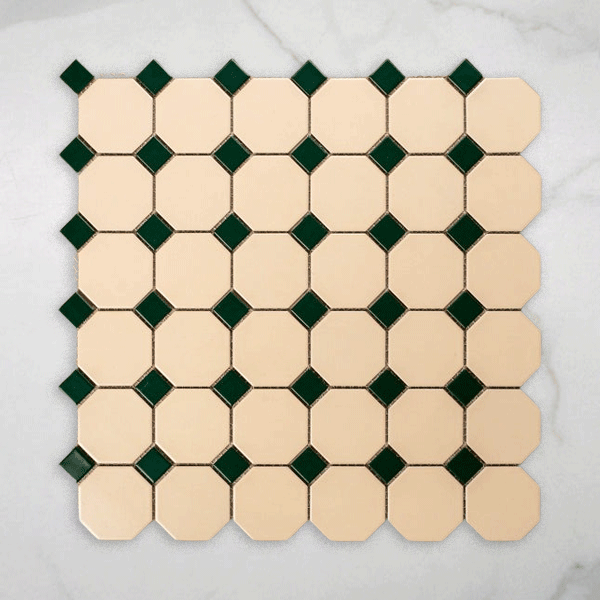
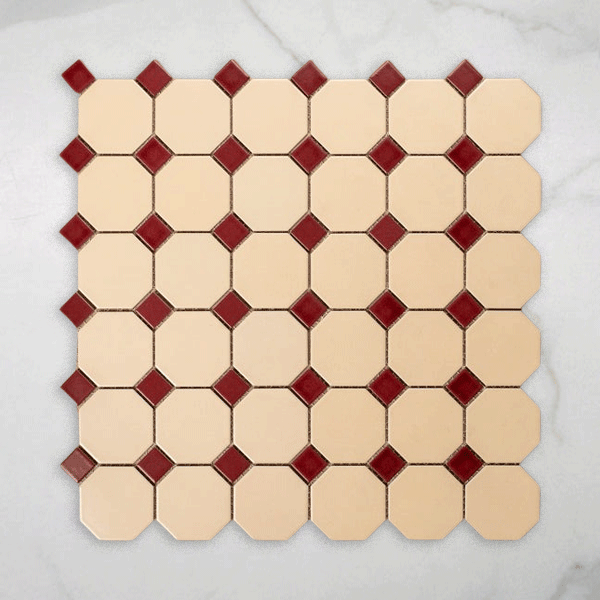
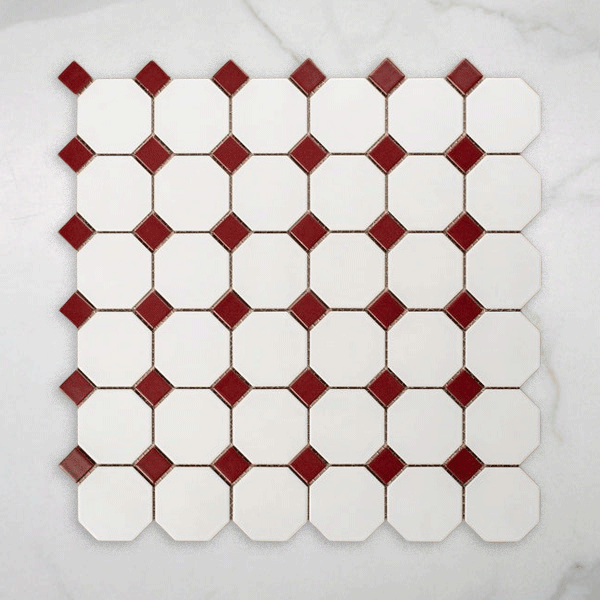
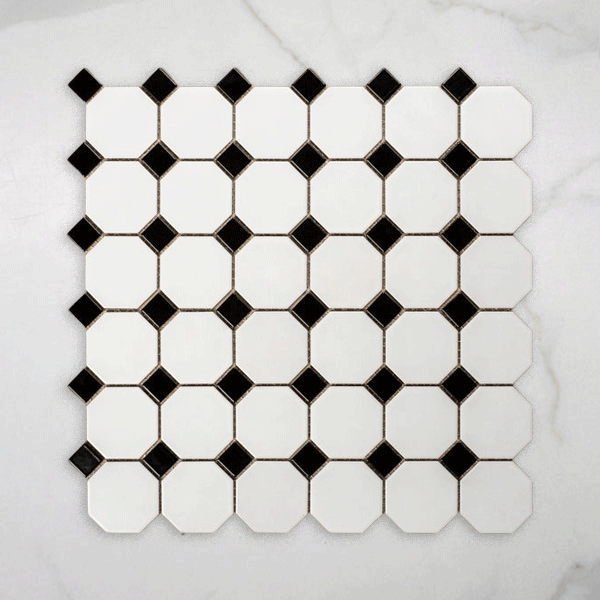
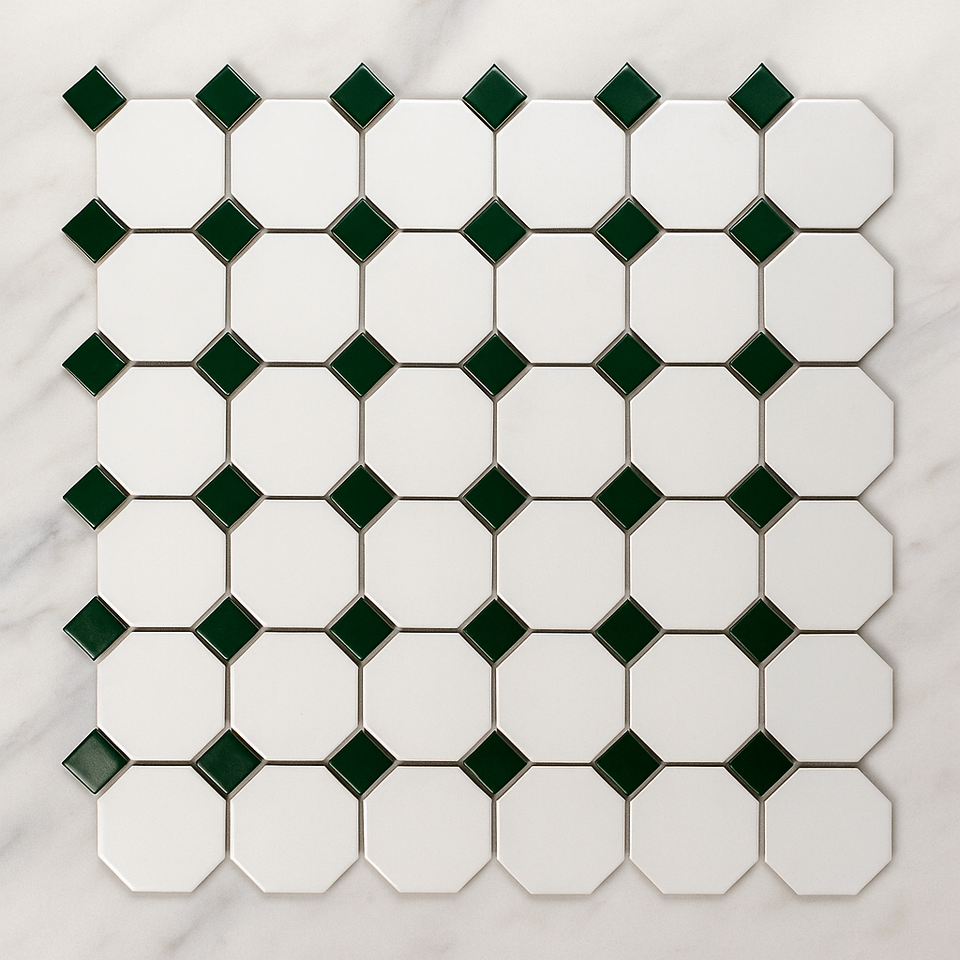
St Kilda is a small range of period style mosaic tiles. Each piece is an octagon, 97 x 97mm, with a small dot in a second colour set into the gap between octagons, and the pieces come on a sheet about 310 x 310mm. It is a classic period style with a modern twist, a cushioned edge for a soft, tactile feel, and a tonal contrast between light and dark accents.
The range is six tiles in six colour pairs. White octagons come with a Black, Green or Burgundy dot in matte, and with a Black dot in gloss. Cream octagons come with a Burgundy or a Green dot in matt. Because the shape, the size and the porcelain body are the same across the range, the choice is about colour, finish and where the tile goes.
The size has its own page at 97x97mm tiles, which covers the sheet format and the wear lines in more detail. This page covers the range as a whole: the six colour pairs, the wear and slip lines, and how to grout and order them. The shape across other ranges is in the octagon and dot tiles collection, and the tiles hub links every other category.
White with Black is the strongest contrast, in both matte and gloss. The black dot outlines the white octagons, so the pattern reads from across the room. The matte version is calm, and the gloss version reflects more light and brightens a small room.
White with Green and White with Burgundy are the matte pairs that add a colour accent. A green dot gives a cool, fresh note, and a burgundy dot gives a deep red accent that suits timber, brass and warm plaster. A Federation octagon dot range comes in the same pairs: white and black, white and green, white and burgundy, cream and green and cream and burgundy.
Cream with Burgundy and Cream with Green are the warmer pairs. A cream base softens the pattern compared with a white one, so the dots read as a quiet accent and not a strong outline. The tonal contrast between the light and dark accents is refined and coordinated.
Pull a secondary colour from the tile into the rest of the room, so the floor feels part of the design. A green dot suggests a green basin, a painted niche or a plant, and a burgundy dot suggests a towel, a painted door or a piece of joinery. The white tiles, beige tiles, green tiles and black tiles collections show those colours across other ranges.
The six tiles carry two slightly different specification styles. Three have a tile size of 97 x 97mm on a 310 x 310mm sheet, a box coverage of 2.3226m², a porcelain material, a non-rectified edge, a V1 appearance and a wear category. The other three have a dimensions line of 300 x 300mm, a matte finish, a non-rectified edge, a V1 appearance, a wear rating of 2 and a box of 25. Treat 310 x 310mm as the sheet and 97 x 97mm as the octagon.
The wear lines are the part to read. The gloss White and Black is Floor Category 1, suited to wall and floor surfaces with low-abrasion wear, with bare or soft-soled shoes. The Cream and Burgundy is Floor Category 2, suited to regular wear with soft shoes or bare feet. The other four have a wear rating of 2, suitable for floors in light traffic areas with soft soled shoes, with a high risk of scratching.
None of the six carries a slip rating, so for a bathroom floor ask the team for the rating of the exact tile. The two spec styles suit bedrooms, bathrooms and an ensuite with no external entry. The bathroom tiles collection shows tiles chosen for the room, with printed ratings.
Only one St Kilda tile is gloss: the White and Black pair. A gloss floor reflects light, shows water marks and footprints more readily, and feels more slippery underfoot than a matte one when wet. Finish matters more than colour, and gloss may show water marks and feel less reassuring on a shower floor than a matte or textured surface.
The gloss tile carries the lower wear category, Floor Category 1, so give it the gentlest use: a wall, a splashback or a dry ensuite floor. The matte pairs suit a floor better, and the matte tiles carry a slightly higher category or a wear rating of 2. For any wet floor, ask the team for the slip rating before you decide.
The gloss White and Black carries a wall tag as well as a floor tag. A wall of octagon and dot is a stronger statement than a floor, because a wall sits at eye level and the pattern fills the view. It suits a small feature, such as a niche, the wall behind a basin, or a short wall in a powder room.
The octagon dot range suits floors and walls, and the rule to keep walls simple applies when the floor carries the pattern. If the wall carries the pattern, keep the floor plain. The wall tiles and floor tiles collections let you compare the range with plain alternatives.
Two tiles need grout lines of 3mm or more for a classic tiled appearance, and the tile is non-rectified with a cushioned edge, a softly rounded edge that gives the floor a hand-laid look. Matching grout softens the pattern and contrasting grout makes each shape stand out.
With a White and Black tile, a light grout keeps the white octagons clean, and a dark grout makes the floor read as black lines on white. With the Cream pairs, a warm grout close to the cream keeps the floor calm. Test the grout beside a loose sheet in the light of the room before the job starts, because wet and dry grout can look different.
Small pieces create more joints than large tiles, and the extra joints give soap residue and dust more places to collect. Epoxy grout can be worth considering in a busy shower because it resists staining when installed correctly. Ask your tiler about the grout for a wet room.
A mosaic floor succeeds or fails before the first sheet goes into the adhesive: the substrate must be sound, clean, correctly waterproofed where required and formed to drain without ponding. Sheet-mounted mosaics reduce repetitive placement but don't remove the need for skill, because the tiler has to check the joint spacing, cut the backing, stagger the joins and lift sections to confirm the adhesive coverage.
For an octagon and dot sheet, the joins between sheets are where the pattern can break. Dry-lay a few sheets and look at the seam. Ask your tiler to plan the layout from a centre line, so the cut sheets fall at the edges in the least visible places, such as under a vanity or at a doorway. Installation must be carried out by a licensed tiler to the appropriate Australian standards.
Tile works well with underfloor heating, and pairing tiles with underfloor heating suits a warmer, drier, mould-resistant bathroom. A small ensuite with a St Kilda floor is a common place for it. Ask your installer about the system and the adhesive that suit the tile.
If a hexagon or a circle suits your room better than an octagon, the penny round tiles collection covers a classic small round, and the mosaic tiles collection covers the wider set of sheet formats. If you like the geometric, federation look at a larger scale, the 316mm x 316mm tiles collection shows Alicante's patterned squares, which carry a P3/R10 rating for dry areas.
The small tiles collection covers other small pieces, and it helps if you aren't sure whether a mosaic is the right scale for the room. A small tile suits a small room, and in a large room a small-format pattern becomes a lot of busy surface.
Sweep and clean with a pH-neutral cleaner for patterned tile floors. Porcelain is a dense, glazed surface that needs no sealing, and a gloss surface wipes clean quickly. The joints need attention: a soft brush and a mild cleaner along the grout lines keep soap film and dust from building up.
Start with a physical sample, because screen colour varies with lighting and surrounding finishes. Order a sheet or a cutting of each pair you are considering, and look at it in the room's own light. The dot colours shift under warm and cool lighting, and a cream can read as yellow or grey.
Order an extra 15% over the exact quantity, to cover breaks and offcuts. Colour, size and texture may vary from batch to batch, so order everything for one room together and keep a few spare sheets. A box covers 2.3226m² on the tiles that carry a coverage figure, and the others come in a box of 25, so ask for the coverage before you calculate.
An ensuite floor 1.5m by 1.8m is 2.7 square metres. A sheet is about 310 x 310mm, so it covers about 0.096 square metres, and the floor takes about 28 sheets before cuts and 32 with 15 percent for cuts around the toilet and vanity. A box covers 2.3226 square metres on the tiles that carry a coverage figure, so the floor takes 2 boxes.
St Kilda suits you if you want a period style octagon and dot floor in a small, light-use room such as an ensuite, a bedroom or a powder room, and you like one of the six colour pairs. The matte pairs give a calmer floor, and the gloss pair brightens a small room.
Look elsewhere if the room has heavy traffic, an external door, a shower base or a need for a printed slip rating, or if you want a plain, quiet floor. The floor tiles collection has plainer options with printed ratings, and the mosaic tiles and small tiles collections cover the other small formats.


