*View accurate shipping rates and availability






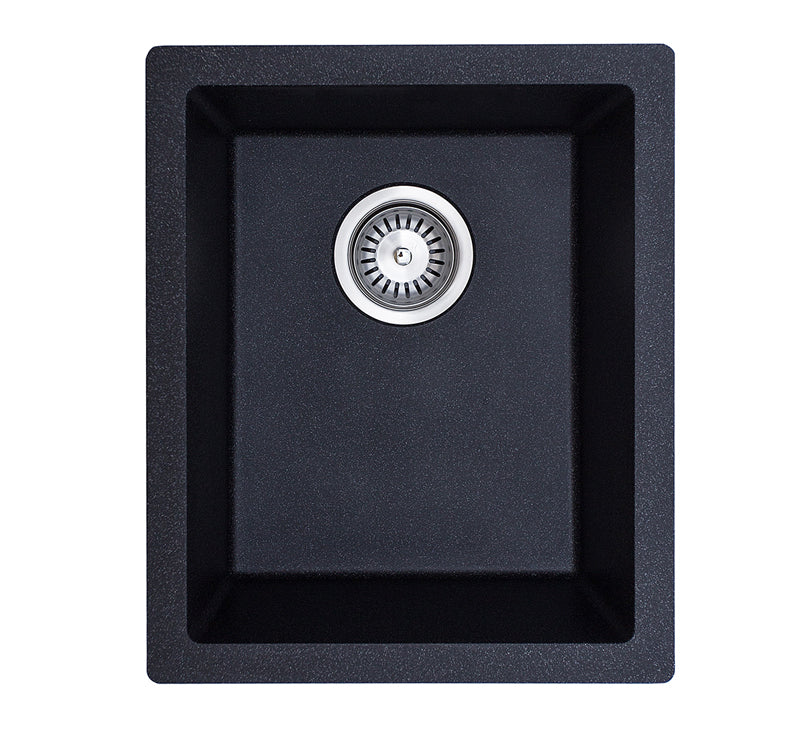
The Como range is the Como Single Bowl Granite Sink from Modern National, a compact black sink that the listing describes as suited to a kitchen, kitchenette or laundry project. It is a small sink, so the questions that matter are whether the cabinet is wide enough, whether to fit it on top of the benchtop or under it, and what the material will put up with. This guide takes those in turn. The sensible default is to measure the cabinet first and to treat the sink's own template or specification sheet as the authority for the cut-out. For the other Modern National sinks, see Modern National sinks.
The listing gives the overall size as 380 x 460 x 194mm and the bowl as 320 x 400 x 170mm. The difference between the two sets of figures is a useful guide to the shape. The bowl sits 30mm inside the outer edge at each side and at the front and back, and the bowl is 24mm shallower than the overall height.
The listing also says the sink has an overflow and includes a stainless steel basket waste, and that it is European made. This page quotes the European made line as the listing's statement. The maker's own homepage, read earlier in this project, does not say where its sinks are made.
The listing names four items: the Como Single Bowl Granite Sink with overflow, a stainless steel basket waste, an installation kit and the installation instructions. The listing does not name the waste size, the clips or fixings in the kit, or the cut-out size. Those details sit in the instructions, which are the first thing to read before the benchtop is touched.
The listing names a kitchen, a kitchenette and a laundry. A retailer sizes guide gives 230 to 460mm as the range for a small sink, which it says suits a bar or a small kitchen, and 500 to 1000mm as normal. The Como is 380mm wide and 460mm front to back, so both sizes fall inside that small range. The listing's own wording, a kitchen, kitchenette or laundry project, is the best guide to where it goes.
The same guide says the sink should be at least 70 to 80mm narrower than the internal width of the base cabinet, which leaves room for the plumbing and hardware. For a 380mm sink that points to an internal cabinet width of about 450 to 460mm. Retailer listings for other small granite sinks back this up. One listing for an undermount-only sink of 380 x 440mm gives a minimum base unit of 450mm, and another for a 460 x 410mm sink gives a 450mm cabinet size. Those are other makers' sinks, not the Como, and the Como's own minimum cabinet size is not in the listing. Ask for it, or read the instructions, before ordering.
For depth, a different guide says to leave 50 to 100mm between the back of the sink and the wall when a splashback is going in, and to keep at least 50mm between the cut-out and the front edge of the benchtop. On a 600mm deep benchtop a 460mm sink leaves room for both.
The listing calls the material hard wearing quartz. The listing does not give a composition. A Houzz guide describes the related material, granite composite, as roughly 80% granite and 20% acrylic resin, and says it resists scratches, chips, heat and most household stains and acids. The finish is matte, the guide says, because of the way the material is made, and the sinks are usually sold in dark hues. A retailer article adds that composite sinks resist dents and stains well and are noticeably quieter than thinner steel sinks.
Quartz composite and granite composite are close relatives and are not identical. The guides describe the family. The Como listing makes no heat, weight or noise claim of its own, so read the guides as the nearest comparison and check the specification sheet. See granite and stone composite sinks for the material in general.
A retailer guide says composite sinks are heavier than stainless steel, so the cabinet may need reinforcing. It says a heavy dropped pot can cause hairline cracks, and that a white sink shows coffee, tea and red wine more than a black one does. The Como is black, which is the shade that guide says hides those stains best. The 380mm size keeps the weight down compared with a large sink, but the listing gives no weight, so ask for it if the cabinet is light.
The listing says the sink suits top mount or undermount benchtop installation, which gives you a real choice. A topmount sink, which sits on the benchtop with the rim showing, works with almost every benchtop, laminate and timber included, according to a retailer guide, because the rim covers the cut edge. The guide also says it is easier to replace later and gentler on the benchtop. Its downsides are a rim that can trap debris and silicone that can peel and let water into the cabinet.
An undermount sink fixes beneath the benchtop with no rim, so crumbs sweep straight into the bowl. The guide says it needs a waterproof solid benchtop such as engineered stone, granite, marble or concrete, and it does not recommend one for laminate or timber. It also says the join collects grime in the silicone and under the benchtop. A Houzz guide says caulking needs replacing every three to five years on both types. See inset sinks for the topmount method.
Which one suits depends on the benchtop first and the look second. Laminate or timber points to top mount. Stone, engineered stone or concrete allows either. In a laundry with a laminate or acrylic bench, the top mount is the safer reading of the guides.
The benchtop is cut to the sink's template or specification sheet, not to the outer dimensions. A retailer guide says so directly, and another warns that a cutting error can mean replacing the benchtop, which is why it advises a professional. The listing says an installation kit and instructions come in the box, and the instructions are where the cut-out should be. For a comparison, one maker's page for a discontinued 430 x 460 x 190mm undermount granite sink gives a 400 x 400mm cut-out, which shows how far the opening can sit inside the outer size. The Como's cut-out will differ, so use its own sheet.
A guide to confirming the opening says to do it before the benchtop is templated, because stone masons often charge for re-cuts. Another says to have the sink on site before the benchtop is cut. Both point the same way: order the sink early, and give the cabinet maker and the benchtop installer the sink's own paperwork.
The listing does not say how many tap holes the sink has, or where. A retailer guide says most sinks have one or two, and to check the count against the tap. If the listing does not settle it, the product page or the instructions will. A small sink suits a standard mixer. A retailer guide says a deep sink may need a taller mixer or a pull-out, and that clearance and splash matter. The bowl here is 170mm deep, which a sizes guide places in its shallow band of 150 to 200mm. See kitchen taps for the options.
The listing says the sink has an overflow and that a basket waste is included. The listing does not give the waste size, so check it against the pipework before the plumber arrives. A retailer guide says connecting the water supply and the tapware needs a licensed plumber in every state and territory. If the waste has to change, see sink wastes.
People ask whether a hot pot can go straight into a granite composite bowl. A retailer article says hot pans can be placed directly in a composite bowl without issues. The Houzz guide gives a limit of 535 degrees Fahrenheit, about 280 degrees C, for granite composite and says high heat does not cause fading. Another maker's granite sink listings give the same 280 degrees C and still recommend a surface protector for hot pots. The Como listing states no heat limit, so check the specification sheet before relying on a figure.
Two makers publish care routines for their own composite sinks, and they agree. One says to wash with soap, hot water and a soft sponge, rinse, and dry with a soft microfibre cloth to prevent limescale and water spots. The other says limescale builds up around the mixer tap, and recommends an acid-based cleaner such as vinegar or citric acid, wiped and dried. Both say to avoid scouring pads, wire wool and abrasive cleaners, and one lists chlorine-based cleaners, drain cleaners, lyes and solvents as things to avoid. The Houzz guide says to wash daily with a soapy nylon brush in circular strokes and dry with a cloth. The Como listing gives no care text, so follow the instructions in the box.
A dropped pot is the main risk for a composite bowl, according to a retailer guide. A guide says a grid protector sits just above the basin floor, prevents scratches and helps drainage, and lists clip-in colanders, drainboards, chopping boards and roll mats as the usual accessories. The listing does not name matching accessories for the Como. A 320 x 400mm bowl is small enough that an accessory has to be sized to it, so measure the bowl and not the outer edge. See kitchen accessories.
When a Como replaces an old sink, the old opening sets the limit. A retailer guide says to measure both the base cabinet and the existing benchtop cut-out before you order. Compare the old cut-out with the Como's template before ordering. A retailer guide says the rim of a topmount sink covers the cut edge, so a top mount fit is the more tolerant of the two methods.
A single bowl is an uninterrupted basin with room for large pots and trays and simpler plumbing, a retailer guide says. It adds that a single bowl suits a household with a dishwasher that rarely hand-washes full loads. A double bowl lets you do two jobs at once but the divider limits large items. At 380mm wide, the Como is a single bowl with no room for a second basin, so the choice between layouts is already made. See single bowl kitchen sinks for larger single bowls and small sinks for other compact options.
A retailer guide describes stainless steel as light, rust, heat and stain resistant, with some give that means glassware chips less. It also says stainless scratches and shows water spots. Granite composite trades that lightness for hardness: the Houzz guide calls it scratch and chip resistant and non-porous, and a retailer guide says it is quieter than thinner steel. The cost of the swap is weight, and the guide says that may mean cabinet reinforcement. For a 380mm sink the weight question is smaller than for a large one, but it is still worth asking. See stainless steel sinks if steel is the better fit for the cabinet.
Measure the internal width, depth and height of the base cabinet, as the Buildmat buying guide advises, and compare the width with the 70 to 80mm rule. Decide the benchtop material, which settles top mount or undermount. Ask for the Como's cut-out size, the tap hole detail and the weight, none of which the listing states. Confirm who is fitting the sink and the tap, because a licensed plumber is needed for the water connection. Then place the order and give the cabinet maker the sink's paperwork before the benchtop is cut.
This page covers the Como sink only. For black sinks from other makers, see black kitchen sinks. If you have not settled on a layout, the main kitchen sinks page lists every range. One guide counts 20 to 30 uses of a kitchen sink a day, so the size, the mounting and the tap position are worth getting right before you order.