
*View accurate shipping rates and availability






95 Items


Up to 70% off across the store, plus free towels and mirrors up for grabs on orders over $800*


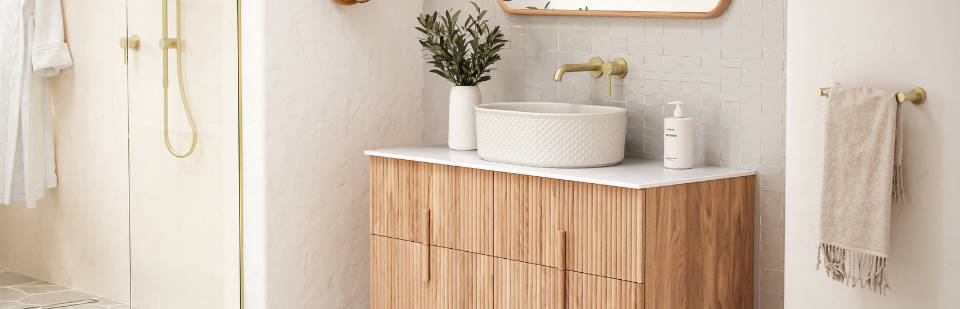


A heated towel rail warms the towel while it hangs, so the towel dries between uses instead of sitting damp on a hook. A wet towel is usually dry within a few hours, and it is warm when you reach for it. For most Australian bathrooms the right call is a dry electric rail on a switch or timer, sized to the wall you have and wired to suit your power point.
A heated towel rail, a heated towel rack and a towel warmer are the same product, so the advice below applies to all three. The sections cover how the types work, who installs each, how much electricity a rail uses, and how to pick a style, size and finish. Links lead to the collection that narrows each choice.
Nearly every rail in this collection is dry electric. A sealed element inside the bars heats the metal directly. These rails typically draw 30 to 250 watts and warm up in 10 to 15 minutes. The surface settles at roughly 40 to 60 degrees, depending on the size and voltage of the rail.
Liquid-filled rails work differently. An element heats an anti-corrosion fluid, so the rail takes about an hour to reach working temperature and gives a gentler heat. The liquid filled heated towel rails collection holds them. Hydronic rails run from a home hydronic heating system and need a licensed plumber, which only makes sense where that system already exists.
Power type decides who can fit the rail and where the cable has to reach. Settle it before choosing a style, because it is the hardest detail to change once the wall is finished.
| Power type | Who installs it | What to know |
|---|---|---|
| Plug-in 240V | You can mount it and plug it in | Needs a power point within reach of the cord. Freestanding rails are plug-in only, which makes them the simplest to move. |
| Hardwired 240V | A qualified electrician | The wiring is concealed, so no cord shows. Some models can be hardwired or plugged in, and others are hardwired only. |
| 12V with a transformer | You can mount the rail, and an electrician connects it to the power supply | Some 12V rails come with the transformer and others need one bought separately. One transformer can run more than one rail on some models. |
The 12 volt heated towel rails collection holds the lower-voltage rails, and 240V heated towel rails holds the mains-powered ones. Before you order, check which power type the rail uses and what comes in the box.
Wiring position matters as much as voltage. Some rails let the installer pick a top or bottom, left or right cable exit. Others have a fixed exit, such as a bottom mount. Confirm which applies before the wall is set out, so the cable and the power supply end up where the rail needs them.
Divide the rail's wattage by 1,000, then multiply by the hours it runs each day. The wattage is on a sticker on the back of the rail and in the specification. A 90 watt rail running six hours a day, three in the morning and three in the evening, uses 0.54 kilowatt-hours. A tumble dryer draws around 3.3 kilowatts while it runs, more than thirty times as much as that rail.
A rail can stay on all day, but a switch or timer limits the running hours to the ones that count. Dry electric rails warm in 10 to 15 minutes, so a timer that switches on shortly before showers suits most households.
Style comes down to how many towels need drying at once and how much clear wall is available.
| Style | Towels it dries | Best suited to |
|---|---|---|
| Heated towel ladders | Four or more, up to seven on some models | A family bathroom with a clear stretch of wall |
| Vertical rails and single bar rails | One or two | Ensuites and the narrow wall between a door and a vanity |
| Horizontal rails | Depends on the length and the number of bars | A wide, low wall where height is limited |
| Freestanding and swivel rails | Depends on the number of bars | Rooms where a fixed wall rail does not work; swivel rails pivot out from the wall |
Most heated towel ladders are wall mounted. Freestanding rails stand on the floor and plug in, and they have a collection of their own. Ladder rails also come with a different profile: floor to ceiling, square bar and curved bar versions change the proportions without changing how the rail works.
Many rails are sold individually, and fitting two or three side by side dries more towels and gives a repeating look. Caroma 12V rails heat best in a group of two or three on one transformer. Some rails also take a hook on the bar, which gives a robe or a second towel somewhere to hang without crowding the bars.
Bar count runs from a single bar up to ten, and each extra bar adds hanging space and heated surface. Profile shapes the look of the room: round rails read softer, square rails read cleaner and more architectural, and oval bars sit between the two. All of them heat the same way.
Measure the wall before the rail. Overall size is the footprint of the rail on the wall. Fixing centres are the distance between its mounts, and the two numbers differ: a rail 632mm long can mount at 600mm centres. Plan the holes from the fixing centres and the clear wall from the overall size.
Leave clearance above and below the rail so air moves around the towels and they hang free. Many bathrooms have only 500 to 700mm of usable wall once door swing and the vanity are allowed for, which makes width the first filter to apply. Rails here run from under 500mm to over 1000mm wide:
Most rails are stainless steel, which handles bathroom humidity well, and the finish is applied over it. The rail is seen every day, so match its finish to the tapware and hardware already in the room.
Cool finishes sit well with white tiles, grey stone and chrome tapware. They are chrome, brushed nickel, brushed stainless steel and gunmetal. Warm finishes suit timber, beige stone and brass tapware, and the choices are brass and gold, bronze and champagne. Black gives the strongest contrast against light walls. White disappears into a minimal scheme.
The rails here carry ratings from IPX4 to IP65, and most are IP55, which protects against dust and low-pressure water jets. The rating and the bathroom electrical zones set out in AS/NZS 3000 together limit where a rail can sit. Check the specification for the zones the rail is permitted in, and confirm the spot with your electrician when the rail is hardwired.
Control varies by model. Many Thermogroup rails have no switch on the rail and are wired to a standard wall switch or a timer. Many Phoenix rails have an integrated on and off switch. Some Turner Hastings rails have no switch, for a cleaner look, and run from a timer or a switch in the bathroom. Decide how the rail will be switched before the wiring is planned, because a timer or switch needs its own position on the wall.
The controllers and thermostats and Thermogroup timers and thermostats collections match a control to the rail.
No single brand is best for every bathroom. Voltage and width decide most of the choice. Finish and the way the rail is switched settle the rest, and the brand follows from those. Each brand collection keeps its rails together, which helps when you are matching an existing bathroom.
For a household that showers daily, yes. A rail dries a wet towel within a few hours and keeps it warm for the next use. That also cuts the damp smell that builds on a towel left wet. Running one for a few hours a day takes far less electricity than a clothes dryer.
Heated towel rails sit alongside the other ways to warm and ventilate a bathroom. The bathroom heating and ventilation collection brings them together with heaters and fans. For a plain-language explanation of how the rails work, the heated towel rail guide covers the basics.


