
*View accurate shipping rates and availability






4 Items

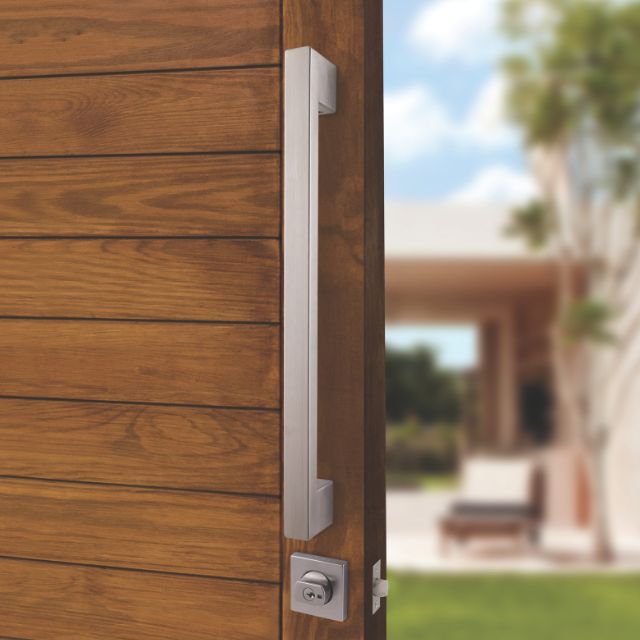


The Lockwood Paradigm pull handle lockset puts a long stainless steel pull handle and a high security lock into one entrance set. The outer handle is 600mm long, the inner handle is 500mm long, and both are 30mm wide in 304 grade stainless steel, in matte black or satin stainless steel. The range has three types: a double cylinder deadbolt, a self-latching deadlatch for apartment and semi-commercial doors, and a dummy pull handle for the second leaf of a double door. This guide explains how the types differ, what the security features do, which door thicknesses and holes the set needs, and how to choose, fit and look after one. Other Lockwood locks are on Lockwood deadbolts, and the brand overview is on Lockwood.
Most entrance sets pair a lever or knob with a separate lock. The Paradigm combines a big pull handle and the lock in one design. The outer handle is the long vertical bar you see from outside. The inner handle is the shorter bar on the room side. The lock body sits in the door and is worked by the key from outside and by a turn or a key from inside. The result is a clean, modern front door with a strong vertical line and no separate lever or knob.
The handles are 304 grade stainless steel, a brushed satin stainless finish or a matte black finish. The fixings are concealed, so no screw heads show on the bar, which keeps the surface plain.
| Type | Finish | What it does | Door thickness | Backset |
|---|---|---|---|---|
| Double cylinder deadbolt | Matte black | Locks with a key from both sides | 32 to 48mm | 60 to 70mm, adjustable latch |
| Double cylinder deadbolt | Satin stainless steel | Locks with a key from both sides | 32 to 48mm | 60 to 70mm, adjustable latch |
| Deadlatch, self-latching | Satin stainless steel | Latches on its own each time the door closes | 32 to 48mm, with a spacer for 32 to 36mm | 60mm |
| Dummy pull handle | Satin stainless steel | Does not lock, for a second leaf | 32 to 48mm | Not applicable |
A deadbolt is a solid bolt that you throw with the key. It does nothing until you turn the key, so the door can sit closed but unlocked. A deadlatch latches by itself. When the door closes, the latch engages straight away, and the key is needed to open it from outside. That behaviour is why the self-latching version is the one chosen for apartment and semi-commercial doors, where the door must latch every time it closes. The deadlatch set is built for use on fire door assemblies and is rated for up to 2 hours, so it suits an apartment block entrance or a tenancy door.
Which suits a house? The deadbolt versions suit a front door where the household locks the door deliberately. The deadlatch suits any door that has to close and secure itself without anyone turning a key, such as a shared entry. Check the fire and access requirements of the building before you choose.
A double cylinder deadbolt needs a key from both sides. That is strong against a break-in through a glass panel beside the door, because a thief cannot reach in and turn a thumb turn. It also means anyone inside needs a key to leave when the door is locked. Keep a key in a fixed place near the door, out of sight from outside, and make sure everyone in the house knows where it is. For a door that is an exit in an apartment building, a rental or a business, confirm the exit requirements with the building manager before you choose a key from both sides.
The Paradigm lock uses DualSelect. Turn the key to the first position and the lock is in safety mode. Turn the key further and the lock goes into secure mode. In effect it gives you two levels from the one key. The deadbolt versions carry the Safety Release and LockAlert features of the Paradigm 005 deadbolt as well, so check the product page for how each works on your set.
The bolt and latch are high security cut resistant stainless steel. The cylinder is a 5 pin tumbler with a brass cylinder and brass barrel, with Kinetic Defence that resists bumping and picking. There are 78,000 key combinations, and each lock is supplied individually keyed with two keys. The lock conforms to the security and durability requirements of AS 4145.2-2008, with the classification SL8D8C6K5. The deadbolt uses a counterbalance bolt, which spreads the load between the door and the frame.
The lock sets come with door magnets. When the lock is in passage mode, the magnets hold the door in position, so the leaf stays where you leave it instead of swinging about. The deadbolt box lists two magnets, so confirm the contents on the product page for the set you choose.
The Paradigm fits doors from 32mm to 48mm thick. The self-latching deadlatch needs a spacer on doors 32 to 36mm thick, and the spacer is supplied in the box. Measure the door thickness at the edge, not at the face where a moulding can add a few millimetres. If the door is thinner than 32mm or thicker than 48mm, the set will not fit.
The set is a surface mount design. It needs one 54mm hole, one 16mm hole and one 25mm side bolt hole in the door. A drilling template is in the box, so the holes can be marked accurately from the template. The deadbolt backset is adjustable between 60 and 70mm, which suits most prepared doors, and the deadlatch is 60mm. The box also holds the inner and outer handles, a square packer, a square internal rose, the strike and strike box, the cylinder tailbar, the fixing screws, two keys and an Allen key. Read the instructions once before you drill, because the order matters for a pull handle that is fixed through the door.
The pull handle is fixed through the door, so the order of work matters.
Testing with the door open first matters on a double cylinder set, because a lock that sticks is far easier to fix before you are locked out or in.
The outer bar is 600mm long and the inner bar is 500mm long. The inner bar is shorter because it has to clear the lock body, any furniture behind the door and the wall it opens against. Check the swing of the door before you drill, so the 500mm inner bar does not strike a wall, a cabinet or a radiator. The bars are 30mm wide, which is slim enough to look neat on a tall timber door and broad enough to grip with a full hand.
Each lock leaves with two keys, and each lock is keyed on its own, so a second Paradigm on another door will have a different key. Keep a spare key with someone you trust. If a household uses several doors, plan which doors share a lock system before buying, because separate keys on separate doors add up quickly.
The dummy handle is a non-functioning pull for a double door. Fit the working lockset on the active leaf and the dummy on the other leaf, and the two doors match from both sides. It uses the same 600mm and 500mm bars, the same stainless finish and the same concealed fixings. The box has the inner and outer handles, a rear plate, the fixing screws, the drilling template, the instructions and an Allen key. A dummy handle does not secure the leaf. For that, the second leaf needs bolts or a lock of its own, and flush bolts and barrel bolts suit that job.
Matte black is a strong modern choice on a timber or dark painted door. It looks best when the rest of the entry is black as well, including the hinges and any letterbox. Satin stainless steel is neutral and works on timber, aluminium and glazed doors. Both finishes cover the same 304 grade stainless steel, so the choice is about how the door should look. For a black entry, see matte black door handles.
A pull handle lockset sits on the door and works with other parts. Hinges carry the weight of the leaf, a stop protects the wall and the bar, and a closer or a threshold finishes the opening. Keep the finish consistent. The related ranges are entrance pull sets, entry door lock sets, deadbolts, pull handles and Lockwood door stops.
Wipe the handles with a soft cloth and mild soapy water, then rinse and dry. Avoid abrasive pads and strong chemicals, which can scratch the stainless steel and mark the matte black. Keep the keys and the cylinder dry, and wipe the keyed side of the bar as well as the outside, since hands touch both.
Check these before you order and again before you drill.
Choose the double cylinder deadbolt for a front door where you want a key lock from both sides and a long, clean pull handle. Choose the self-latching deadlatch for an apartment or semi-commercial door that has to latch each time it closes. Add the dummy handle to the second leaf of a double door. Measure the door thickness, mark the holes from the template and keep a key near the door when you use a double cylinder.


